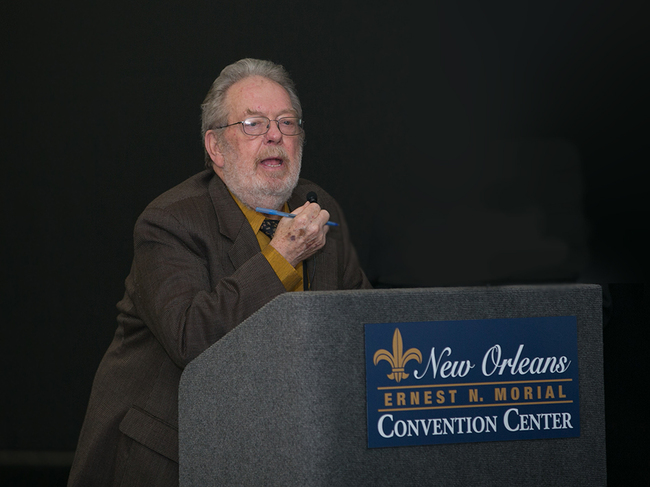
On Sunday, August 30, 2026, P. David Pearson, one of the all-time most influential scholars in the field of literacy education, died after a yearlong fight with bladder cancer. He was 85.
His son, Matthew, shared the news in a public post on Pearson’s Facebook page and included a link to the online cancer journal his father had been keeping. The last few entries were not from Pearson, but by Matthew and his sister Susan, whose poignant contribution referenced Pearson’s “epic academic career” only briefly.
“I can't and won't recount his contributions to the field of early childhood literacy here,” she wrote. “That's a task for his colleagues and professional friends.”
Those from the literacy field who spoke at Pearson’s Celebration of Life, however, kept the focus on Pearson the person—and for good reason.
“The culture of academia can sometimes be prickly and competitive,” said Gina Cervetti, Pearson’s longtime friend and collaborator. “But David’s instinct was to acknowledge and include and lift up everyone around him.”
“His attitude toward life and work was ‘the more, the merrier,’” she said. “His deeper instinct was always to make people feel like they belonged.”
To illustrate her point, Cervetti shared an anecdote about helping Pearson put together the invitation list for his
Festschrift a few years back.
Cervetti said she panicked when she saw that his list had grown to include 619 people (“Because rooms have maximum capacity,” she quipped). Pearson’s take was a bit different. He told her that he knew not everyone would attend, but regardless, he wanted all 619 to know that he had thought of them.
It was in the same spirit that Pearson’s family issued an open invitation to his memorial, both in person and via livestream. The majority of those who spoke were members of Pearson’s family or personal friends. Even the few who first met Pearson in professional contexts spoke very little about his extraordinary body of work.
Cervetti, for instance, began her remarks with the simple statement that Pearson “changed the way we teach children to read,” then added, “I could speak for hours about David as a scholar and leader, but that isn’t what’s in my heart today.”
The same went for Freddy Hiebert, who recalled how she had once mentioned to Pearson that driving California Highway 1 with the top down was on her bucket list. They were both living in the Midwest at the time, she said, but when they met up at a conference in San Francisco, Pearson was waiting for her with a convertible.
Hiebert and Cervetti both talked about Pearson’s mentorship and the incredible personal recommendations he’d written for them and countless others early in their careers, shaping the trajectory they would follow. It wasn’t unusual for the line between professional and personal to disappear in the process.
“My academic mentor became my collaborator, my collaborator became my friend, and my friend became one of the most important people in my life,” Cervetti said tearfully.
It turns out that Pearson was one of the most important people in a lot of lives. Their stories were punctuated by family members reading poetry Pearson had penned later in life as well as a friend who sang and played guitar. The eclectic, pre-event playlist included everything from “Amazing Grace” to “Graceland.” And for all of these reasons, despite being open to the public, Pearson’s memorial felt intimate and, at times, deeply personal.
More tributes to P. David Pearson will emerge over the coming weeks. And while many of those will include highlights from an extraordinary career, it is almost certain that Pearson’s legacy won’t be limited to what appears on his CV.
As Cervetti said, “David took pride in his accomplishments, but I think he took even more pride in all the people he had helped along the way.”
Editor's note: This article is part of a series of reflections honoring P. David Pearson's lasting legacy. For more, read his memorial and a message from Patricia A. Edwards.