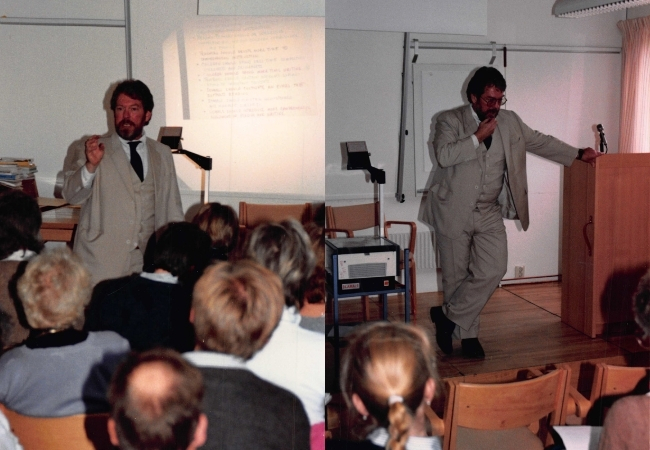
(Photos courtesy of Matthew Pearson)
Sunday, August 30, 2026, brought news that I was simply not prepared to receive—the passing of my dear friend and colleague, P. David Pearson.
I am still trying to absorb the reality that David is no longer with us.
There are some people whose presence in our lives becomes so familiar, so enduring, and so deeply connected to the history of our professional journeys that it is almost impossible to imagine the world without them in it. For me, David was one of those people.
My memories of David go back much farther than many people might realize.
I first had the opportunity to meet David when I was a very young graduate student at the University of Wisconsin–Madison and he was a very young assistant professor at the University of Minnesota. Neither of us could have known then where our professional journeys would take us, but I remember being impressed by David.
There was something about his intellect, his curiosity, and the way he thought about reading and learning that made me believe I was meeting someone who was going to make a significant contribution to our field. In fact, I made a prediction: P. David Pearson was going to become a world-renowned scholar. (Spoiler alert: I was right.)
One of the things I admired most about David was his unwillingness to accept simple answers to complicated questions. He understood that literacy learning is complex because children are complex. He knew that teaching is complex because teachers make consequential decisions every day. And he understood that research should illuminate that complexity rather than erase it.
David challenged ideas without diminishing people. He understood that rigorous scholarship did not require intellectual arrogance. He could disagree with you and still make you want to continue the conversation—a truly rare gift.
Years later, when I served as president of the National Reading Conference (now the Literacy Research Association), I invited David to deliver the keynote at our annual conference. I knew what he would bring to that audience: Intellectual rigor, insight, provocation, humor, and an extraordinary ability to make us think differently about questions we thought we already understood.
He did not disappoint.
When David finished speaking, he received a 15-minute standing ovation. And as I watched hundreds of literacy scholars rise to their feet to honor him, I thought about the young assistant professor I had met years earlier when I was a graduate student at Wisconsin.
I will never forget that moment.
It is impossible to talk about David without acknowledging the magnitude of his contribution to our field. He fundamentally changed how generations of educators understood reading comprehension by helping us recognize that comprehension is not something that simply happens after children decode words—that readers actively construct meaning, bringing knowledge, experiences, language, expectations, and purposes to their encounters with texts. And his work on the gradual release of responsibility provided educators with a powerful way to conceptualize teaching: Teachers model and support learning, students participate with guidance, and responsibility gradually shifts until learners can act independently.
Right now, however, I am not thinking first about P. David Pearson, the internationally renowned scholar.
I am thinking about David, the person.
I am thinking about my colleague.
I am thinking about my friend.
Editor's note: This article is part of a series of reflections honoring P. David Pearson's lasting legacy. For more, read his memorial and Celebration of Life.