Newly elected ILA Board member-at-large Cheron H. Davis, an associate professor at Florida A&M University, shares a personal reflection on the experiences and professional communities that shaped her path in literacy.
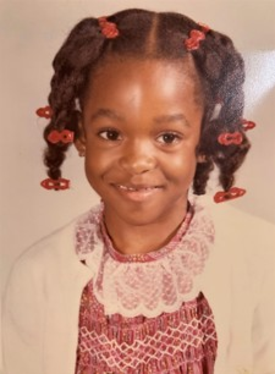
Before I ever walked into a kindergarten classroom, I was already reading. My mother read to me often, and somewhere along the way, the words on the page began to unlock themselves. Books became my favorite companions. They carried me to places I had never seen and introduced me to people I would never have met. Reading felt like
magic.
When I entered kindergarten at Little Woods Elementary School in New Orleans, my teachers quickly realized that coloring worksheets and learning letters would not keep me occupied for long. Before I knew it, I was spending part of my day in a first-grade classroom for language arts instruction. Five-year-old me thought I had arrived. Then something happened that I have never forgotten—the other first graders knew something I didn’t.
Every day, they recited sounds. They sang phonics songs. They manipulated language in ways that seemed completely foreign to me. I could read the books and I could answer the questions, yet there was a gap. I remember sitting there, wondering how they knew things about words I didn't. At five years old, I could not explain it. Today, I can.
Those students were receiving systematic phonics instruction I had not, and that experience stayed with me. It followed me through my undergraduate studies into my own elementary classroom, and eventually into my work as a literacy researcher and teacher educator. It also shaped how I think about one of the most important conversations happening in literacy education today. Back then, however, nobody was calling it the Science of Reading. Yet much of what we now identify as evidence-based literacy instruction was already part of my educator preparation at Auburn University and later part of my teaching practice. I taught phonemic awareness, phonics, vocabulary, fluency, and comprehension. We just called it teaching.
Knowing how to read and wanting to read are not the same thing
The little girl in that picture up there did not fall in love with books because of a phonics lesson. She fell in love with books because they gave her access—to ideas, to knowledge, to possibilities, and to the world.
Like so many children of my generation, I watched PBS’
Reading Rainbow. Every episode introduced me to new books, places, perspectives, and ways of thinking. Long before I understood terms like background knowledge or schema,
Reading Rainbow helped me build both. It expanded my world one story at a time. Looking back, I realize that literacy was teaching me something much bigger than how to read words. It was teaching me how to understand the world.
That lesson would stay with me through my years as a classroom teacher, as I pursued graduate school, and as I joined literacy organizations—first at the local level, then at the state level, and eventually at the international level. Like many literacy professionals, my journey with professional organizations began with showing up. I attended conferences, listened, learned, volunteered, and asked questions. I found my people.
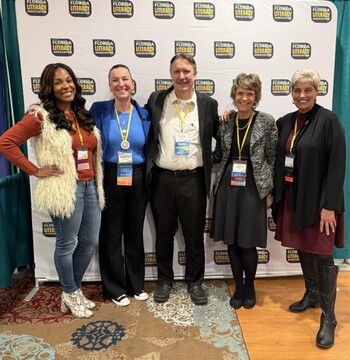
In Alabama, I became involved locally with the Plains Reading Council and later the Alabama Literacy Association. After moving to Florida and building a life and career here, I found another professional home in the Florida Literacy Association. Through both organizations, I met educators and scholars who challenged my thinking and deepened my commitment to literacy as a force for change.
Then, in 2013, I presented for the first time at the then-International Reading Association Annual Convention in San Antonio, Texas. For a literacy nerd like me, it was a dream come true. LeVar Burton was there, Mr. Reading Rainbow himself was in attendance, and so was Mo Willems. I remember thinking about how many of the people in that room had shaped my understanding of literacy, books, teaching, and learning. These were people whose work I admired. People whose books I owned, whose ideas had influenced my teaching and scholarship, and who I absolutely fangirled over.
That conference felt pivotal—not because I met celebrities or because I presented. For the first time, I began to see myself as part of a larger literacy community.
Joining a community committed to changing lives through literacy
Over the years, my involvement with ILA continued to grow. I served on committees, I volunteered, and I said yes when opportunities appeared. Eventually, I found myself serving on and even chairing committees alongside scholars whose names had once appeared only on book covers and in journal article references. The people I had admired from afar became colleagues, mentors, and friends. The scholars whose work had shaped my thinking welcomed me into conversations, encouraged my growth, and challenged me to contribute my own voice to the field.
That is the power of organizations like ILA: They do more than advance literacy. They cultivate people.
This brings me back to the little girl in that picture up there. She had no idea where literacy would take her. She did not know that
Reading Rainbow was doing more than entertaining her after school. She did not know that books were quietly expanding her understanding of the world. She did not know that every story she read was helping her imagine a future she could not yet see. She did not know she would become a classroom teacher. She did not know she would become a professor. She did not know she would spend her career preparing future educators, conducting research, and advocating for children.
And she certainly did not know she would one day serve on the ILA Board of Directors. But
literacy knew. Literacy had been preparing her all along.
Today, conversations about literacy often focus on what children need to learn. That conversation matters. The research matters. But so does something else. Joy matters. Identity matters. Relationships matter. The art of teaching matters.
For years, I have argued that literacy education should not force us to choose between science and humanity. That belief ultimately became the foundation for my work on Integrative Literacy Theory. At its core is a simple idea: The Science of Reading. The Art of Teaching. The Promise of Possibility. Children deserve evidence-based instruction. They also deserve teachers who understand that literacy is about more than decoding. Literacy is about agency, opportunity, and belonging. It is about helping children imagine futures they may not yet have the words to describe.
Beginning a new chapter
As I embark on this new chapter of service with ILA, I do so with deep gratitude and tremendous optimism. I believe in the power of literacy. I believe in the educators doing this work every day. I believe in mentoring the next generation of teachers, scholars, and literacy leaders. Most of all, I believe in possibility. Because literacy is not merely the ability to read words on a page. It is the ability to imagine a different future and then write yourself into it.
The little girl in that picture never could have imagined this moment.
Thankfully, literacy imagined it for her.
You Might Also Like
Standing on the Shoulders of a 70-Year Legacy
A Teacher's Experience Overcoming Systemic Hurdles