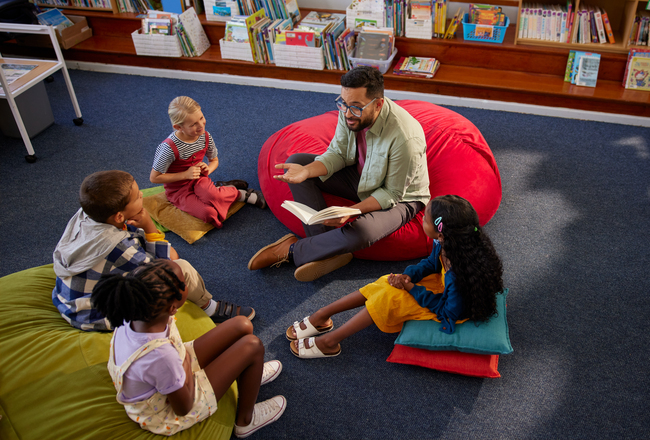
When children believe their ideas matter and their voices are heard, they experience belonging. Nurturing belonging in mathematics means valuing children's ideas, and simple routines—like inviting students to share their thinking, comparing multiple strategies, and listening before correcting—can strengthen mathematical belonging. As children explain how they solved a problem and hear others’ approaches, mathematics becomes a shared human endeavor.
Belonging in mathematics often begins with stories. Whether in the home, community or school, or on laps, couches, or library carpets, educators can make mathematics a place of belonging through picture books. Let’s make belonging count using these five stories.
A cookie, a loop, and a prediction
Consider the enduring favorite
If You Give a Mouse a Cookie by Laura Numeroff. Its charm lies in its circular structure: If you give a mouse a cookie, he’ll ask for milk. Milk leads to a straw. A straw leads to a mirror. Each event leads logically and sometimes hilariously to the next, until the narrative loops back to the cookie.
This playful chain of cause and effect is also mathematical. Children can notice:
- Sequence and order
- Predictable patterns
- If-then reasoning
- Cycles and loops
Pause during reading and ask:
- What do you notice about what keeps happening?
- What do you think will happen next?
- How do you know?
These questions invite children into patterning and logical reasoning. They position children as thinkers. Belonging begins with welcomed ideas. After reading, invite children to map the circular story, count the steps in the loop, or invent a new chain (“If you give a cat a cupcake…”). If children count differently, resist asking, “Who's right?” Instead ask, “
How did you count?” The shift from correctness to curiosity builds confidence and community.
Counting together
Belonging grows when children share in mathematics. In
Imagine Counting All the Stars by Raewyn Caisley, Maddie delights in seeing mathematics everywhere, from shells on the shore to stars in the sky. Yet she longs for someone to share that joy. When she finally finds a friend who shares her curiosity, counting becomes connection.
This story opens mathematical conversations:
- If we wanted to count all the stars, how might we organize them?
- Is there more than one way to count something very large?
- Where do you see math in your own world?
Children might suggest grouping by tens, making arrays, or estimating. When adults respond with “Show me your thinking,” rather than offering a faster method, they affirm that multiple strategies belong.
The story's deeper message echoes the mathematics: Counting is more joyful when done together. Mathematical belonging is relational.
Growing confidence
Belonging means being seen and affirmed. In
Julián Is a Mermaid by Jessica Love, Julián revels in imagination and joins a vibrant parade celebrating self-expression. This visually rich story invites mathematical noticing:
- How many costumes or mermaid tails can you count?
- What shapes do you see in the parade?
- How does the size of the crowd change from beginning to end?
- What changes over time in Julián’s confidence?
Children might compare colors, count parade participants, or notice repeating patterns in costumes. Adults can highlight that noticing differences and similarities helps us appreciate others. Value children's ideas with prompts:
- Show me how you counted.
- Where did you start?
- Could we try another way together?
Mistakes are part of learning and thinking evolves through dialogue. Children who feel safe to revise their ideas are more willing to take risks. Belonging is not about being right the first time. It is about valuing the process.
Building community
In
Strictly No Elephants by Lisa Mantchev, a pet club excludes a child and his elephant. Rather than retreat, they create a new club where all beings belong. Read this story mathematically by asking:
- How many different pets are included in the new club?
- How does the size of the club change?
- What comparisons can we make between the first club and the new one?
- How many friends are needed to begin something new?
Children may count animals, compare group sizes, or track growth over time. The mathematics supports a clear message: Inclusion changes the numbers and the feeling of a group.
Protecting connections
Belonging extends beyond human communities to the natural world. In
We Are Water Protectors by Carole Lindstrom, a community unites to protect water as a shared resource. This lyrical text invites mathematical exploration:
- How many people gather to protect the water?
- What patterns do you see in the waves?
- How far might water travel?
- How does the size of the group compare at the beginning and the end?
Children might notice repetition in illustrations, estimate distances, or compare scenes across time. Mathematics becomes a lens for understanding growth, scale, and collective action. Belonging is local and expansive.
Making it count: Five ways to foster belonging
Prompt with curiosity and care by having the following conversations with children:
- Ask open questions. Replace “What’s the answer?” with “What do you notice?”
- Celebrate multiple strategies. Explore different ways of counting.
- Normalize revision. Frame mistakes as opportunities.
- Connect to daily life. Bake, measure, compare, and estimate together.
- Reflect. Ask, “What math did we discover in this story?”
Weaving mathematics through shared reading is social and cultural. Children can see mathematics in cookies and constellations, in parades and pet clubs, in waves and water. When reading with children, whether it's about a mouse, the stars, a parade, or a debate about equality, pause. Ask what comes next. Count together. Listen closely to children’s reasoning.
These moments strengthen numeracy by saying: Your thinking matters. You belong. That is what truly makes it count.
You May Also Like
10 Strategies for Families to Strengthen Read-Alouds at Home
From Book Selection to Discussion: How to Lead Effective Read-Alouds