 Mentor texts or texts that serve as examples for different types of writing can be especially helpful for writing teachers at every grade level. Teachers can use them as exemplars for good writing or can draw examples of one of the six traits of writing from their pages so that their students know exactly what conventions and presentation, ideas and content, organization, sentence fluency, voice, word choice involve. By relying on published texts that epitomize one of the six traits, teachers can help students gain confidence as they develop into proficient writers. This week’s book reviews from members of the International Reading Association's Children’s Literature and Reading Special Interest Group focus on writing mentor texts. Learning from expert writers or mentors can reap bountiful harvests when it comes to writing and self-expression. Teachers may be interested in checking out “Plugged In: Coming to You Live … Mentor Texts” on Engage or ReadWriteThink's multitude of lesson ideas for using mentor texts. Also check out the teacher-created blog called Teach Mentor Texts.
GRADES K-3
Dahl, Michael. (2013). Goodnight, baseball. Illus. by Christina Forshay.
Mankato, MN: Capstone Press/ Picture Window Books in conjunction with Sports Illustrated for Kids.
 A father/son day at the baseball park is the setting for this book. Told in somewhat uneven rhyme, usually from the boy’s point of view but also from an outside narrator, the thrill and excitement of a baseball game is described. Borrowing the nocturnal pattern from Margaret Wise Brown’s Goodnight Moon (1947), the young boy ends his baseball-filled day saying goodnight to the teams and continues with “Goodnight, diamond. Goodnight grass/ Goodnight, home plate/ where each runner ran past.” (pp. 19 & 20). After reading this book aloud, teachers might pose the question to students about a big day they themselves experienced and how they would say goodnight to the many things that they encountered during that special day. Readers can enjoy a book trailer at the publisher’s website.
- Karen Hildebrand, Ohio Library and Reading Consultant
Fandel, Jennifer. (2012). You can write awesome stories. Mankato, MN: Capstone Press.
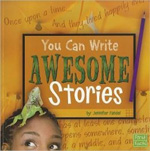 Perfect for beginning writers or even those who are a little bit older but lack confidence about being able to write, this book offers tips for how to tell a story effectively. The author briefly covers essential writing topics such as character development, setting, plot, mood, and dialogue as well as how to add details to a story. The author reminds readers that it’s important to grab readers’ attention from the beginning of the story, but as important as the way a story starts may be, the ending is also important. For each topic, there is an example and an exercise for would-be writers to try out. This is a good introductory text even though it is not comprehensive in its scope. Writing teachers can use the exercises as starting places upon which they can build with their own examples and lessons.
- Barbara A. Ward, Washington State University Pullman
Ganeri, Anita. (2012). Action words: Verbs. Mankato, MN: Heinemann Library.
 Writers, especially those who are just learning to practice their craft, are always looking for words to use in their writing. Part of a series on different parts of speech and words that can add vibrancy to writing, this introductory book provides an explanation of the role of grammar in writing and then offers a brief tutorial on verbs, including examples exploring verb tense and active and passive verbs. The author even acknowledges that passive sentence construction may function in a more gentle way than active construction; for instance, “The boy hit the ball” may be a stronger sentence than “the ball was hit by the boy,” but there are times when passive construction is more appropriate. The book contains examples in simple sentences accompanied by photographs that help young writers understand this important part of speech. Although brief, the book covers a lot of ground. Teachers will want to use this title as a starting place before introducing even more examples of how verbs can enliven sentences.
- Barbara A. Ward, Washington State University Pullman
Nunn, Daniel. (2013). True or false? Seasons; True or false? Colors; True or false? Farm animals; True or false? Transportation; True or false? Weather. Mankato, MN: Capstone Publishers/Raintree.
Almost everyone knows how to play the True and False game. The author has created a series of books that uses this familiar format to present the topics of season, colors, farm animals, transportation and weather. Each book begins with a statement such as: “The Seasons. A season is a period of time. The year is divided into four seasons. How much do YOU know about the seasons?” (p. 4). Each book then launches into statements, or sometimes misconceptions, about the topic. The bottom of each page has a large red and green box asking readers to decide if the statement is true or false. The following page holds the answer as well as explanatory statements. For teachers who are looking for early research activities with young students, this nonfiction series provides a mentor text series of books that will guide the reading and research of primary age students.
- Karen Hildebrand, Ohio Library and Reading Consultant
Parish, Peggy. (1963). Amelia Bedelia. Illus. by Fritz Siebel. New York: Harper and Row.
For fifty years, teachers have been using the many Amelia Bedelia books, including this one, as mentor texts to illustrate vocabulary, idioms, homonyms, and homophones as Amelia and her feather duster share her hilarious mix-up of words and expressions. This year HarperCollins has prepared a 50th Birthday celebration of the character and book that started it all. Teachers can enjoy the downloadable party kit “friend” Amelia on Facebook or Twitter. There are Amelia Bedelia books for a plethora of occasions and everyday situations. Although the book’s originator died in 1988, her nephew Herman Parish picked up the family trade and continued writing the Amelia Bedelia stories. There are numerous videos available on YouTube depicting many, many of the Amelia books through book talks, book trailers, and full readings of her stories.
- Karen Hildebrand, Ohio Library and Reading Consultant
Shapiro, David. (2013). Tool. Time. Twist. A brief history of tools through time. Illus. by Christopher Herndon. Portland, OR: Craigmore Creations.
 Teachers who are looking for a way to introduce simple machines might like to start with this interesting approach to the history of tools, in addition to trying this particular format as a writing prompt or mentor text. Each double-page spread introduces a tool chronologically according to when the tool was developed. Page 2 opens the history with “What’s the tool? Sticks and stones! What’s the time? 2.5 million years ago!” Page 3 continues the chronology, “What’s the twist? Humans and our ancestors are not the only ones to use tools. Otters, octopuses, chimpanzees, and crows have all been known to use them too.” The format is launched, and the Tool Time Twist begins. This writing pattern could be applied to any nonfiction topic as guided research for information.
- Karen Hildebrand, Ohio Library and Reading Consultant
GRADES 3-5
Asselin, Kristine Carlson. (2013). Think for yourself: Avoiding plagiarism. Mankato, MN: Capstone Press.
 After defining what plagiarism is for those who may not know or who may regard copying someone’s words as a form of flattery, the author offers suggestions about how to avoid it and why someone else's work cannot be used without crediting the source. This is an excellent introductory text on plagiarism since students often start writing reports during the early years of school. A unit on report writing and research would be remiss if it failed to address this particular topic since even many college students don't realize what plagiarism is, why it's wrong, and its possible consequences. Colorful photographs showing young scholars hard at work accompany the text, part of the Research Tool Kit: Think for Yourself series, the titles of which provide support for academic writing lessons, even on an introductory level.
- Barbara A. Ward, Washington State University Pullman
Florian, Douglas. (2012). UnBEElievables. New York: Simon & Schuster/Beach Lane Books.
 Using poetry as an entrance point to science, nonfiction, or nature is not new. The poet however creates a word-filled world brimming with the warmth of the sun and the variety of a garden, peppered with rhymes that are fun to hear and say, and yes, interesting information in the book’s pages. Readers are introduced to the bee’s world and its various parts, the hive, anatomy, queen bee, drone, worker bees, the bee dance, life cycle, swarm, the pollen and honey. Much of the poetry and information can be discussed with students, read aloud, or used to inspire drawings. This is also a great mentor text for students working on projects involving bees or any life cycle. The book is perfect for an entire class project (where students choose to do a small bit of the whole) or a small group project (where students get to do a part that is of interest to them). Students can practice writing poetry and non-fiction passages by following the text styles. This book is a great addition for classrooms dedicated to exploring the world around us.
- Rani Iyer, Washington State University Pullman
Guillain, Charlotte. (2012). Jobs if you like reading and writing. Mankato, MN: Heinemann Educational Books.
 As is the case with the other titles in this series, this entry in the Jobs if You Like...series encourages young readers to draw upon their skills and interests as they consider the right jobs for them later in life. It’s never too early to begin preparing for a career. Someone who enjoys reading and writing, for instance, might enjoy being a librarian, a journalist, an editor, a bookseller, a translator, or a web content manager, among the other careers listed in the book. The author explains how reading and writing skills are useful in those fields and then includes a table that describes the best part of each job. Some of the jobs such as acting are jobs that many readers will not have linked to reading and writing. The photographs that accompany the text show all sorts of individuals enjoying what they are doing. Maybe with a little more foresight and preparation, more adults will enjoy their own lifework. This book might provide a gentle nudge in the right direction.
- Barbara A. Ward, Washington State University Pullman
Hopkins, Jackie Mims. (2013). Prairie Chicken Little. Illus. by Henry Cole. Atlanta, GA: Peachtree Publications.
 What happens when you cross a Chicken Little story with a new ecosystem? You get a variant on the original Chicken Little story, but this time there is an unexpected “rumbling and a grumbling and a tumbling” (p.1). Mary McBlicken, the prairie chicken, is “out on the grasslands where bison roam” (p.1) when she hears these outrageous sounds, fears “A stampede’s a coming” (p.2), and hightails it back to the ranch. On her frantic trek she runs into her friends the prairie dog, the jackrabbit, the meadowlark, and then … Slim Brody, the sly coyote. Slim helpfully offers to show the prairie friends a shortcut to the ranch. As young readers will predict, Slim is up to no good. Teachers will want to share other versions of the Chicken Little story such as Rebecca Emberley’s Chicken Little (Roaring Brook Press, 2009) or Steven Kellogg’s Chicken Little (HarperCollins, 1985). Teachers might also like to introduce Prairie Chicken Little with this video rendition. They might want to connect a short science lesson with a photograph and paragraph about the endangered Prairie Chicken.
- Karen Hildebrand, Ohio Library and Reading Consultant
Marsalis, Wynton. (2012). Squeak, rumble, whomp! Whomp! Whomp!: A sonic adventure. Illus. by Paul Rogers. Somerville, MA: Candlewick.
 With several distinctive visual and textual references to the sights, sounds, and flavors of New Orleans, this picture book illustrates how much rhythm can be found in everyone’s daily lives. A boy starts off his morning by opening a back door with its familiar squeak and pauses a moment to savor the sounds that typify his home and neighborhood. As he follows the routines of the day, he hears music in the simple act of buttering toast or the sounds made by a barber's clippers gliding along his now-smooth and close-cropped head. The various sounds are interesting enough in their own right, but when they all come together in a cacophony of notes on the book's last pages, readers will be tempted to tap out some beats of their own. This is a great read aloud title filled with several examples of onomatopoeia for budding writers and musicians. The ink illustrations that were finished digitally allow the sounds to receive attention as they move across the book's pages in harmony.
- Barbara A. Ward, Washington State University Pullman
Rissman, Rebecca. (2012). Be the best at writing. Mankato, MN: Heinemann/ Raintree.
 This helpful writing primer provides several simple but effective tips on how to be a better writer. Late elementary and early middle graders will find it helpful to be reminded of the importance of purpose and audience when they choose words for their written pieces as well as the necessity to narrow their focus before they begin a piece. The author even makes suggestions about preparing and polishing a paper so that it looks finished before turning it in and how to get organized before writing or studying. For instance, it’s a good idea to gather all the necessary materials, including snacks, before beginning to write. The tips that have been provided are also tested throughout the book as readers have a chance to respond to a question about writing after each tip section.
- Barbara A. Ward, Washington State University Pullman
Salas, Laura Purdie. (2011). Picture yourself writing poetry: Using photos to inspire writing. Mankato, MN: Capstone Press.
 Teachers and budding writers can find lots of advice on poetry writing in this book. Even if they choose not to write poetry but to use the photographs or exercises as writing prompts, so much the better. Topics range from choosing a topic or focus for a poem to enhancing a piece by adding sensory details, moody verbs, unexpected words, unusual characters, and even arranging words on a page to create the intended effect. The author even discusses concrete poems and provides brief examples of all the techniques being explored in the book. This is a great writing primer, filled with ideas teachers can use with little modification. Readers will wish for even more tips, examples, and full-page photographs to inspire writers. This title is sure to build confidence in even the most inexperienced writing teacher.
- Barbara A. Ward, Washington State University Pullman
These reviews are submitted by members of the International Reading Association's Children's Literature and Reading Special Interest Group (CL/R SIG) and are published weekly on Reading Today Online. The International Reading Association partners with the National Council of Teachers of English and Verizon Thinkfinity to produce ReadWriteThink.org, a website devoted to providing literacy instruction and interactive resources for grades K–12.