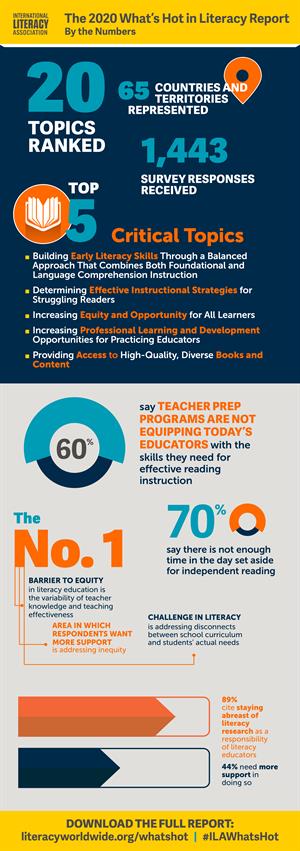
 The first assignment that Elizabeth LaGamba, assistant professor at Slippery Rock University in Pennsylvania, gives to her Current Issues in Reading Research graduate students each semester is to read the most recent What’s Hot in Literacy Report from ILA. In addition to sharing their feedback with the class, one of the requirements is to send their response to ILA.
We have enjoyed reading the thorough and thoughtful responses for the past several years, and so we recently asked LaGamba to write an article for Literacy Today, our member magazine, about why she includes this as an assignment in her class and what it is about the report that she finds valuable.
You can find her article, “A Guide to Professional Growth: Using The ILA 2020 What’s Hot in Literacy Report to Frame Our Study of Current Issues in Reading Research,” in the March/April issue.
Here we share the feedback we received from her students in January when the 2020 report was released.
“An area that I feel needs more attention is the lack of resources and texts for literacy development. Technology makes it more challenging to engage students in real text. This can create a barrier when building an effective library. ESL students discussed in the report, specifically ages 15–18, truly suffer when it comes to library resources. However, as a secondary teacher, this continues to be a struggle for my [English-speaking] students as well. I hope to view additional research that aligns with supporting students with self-selecting texts. I also hope to learn more about expanding my personal literacy library within my classroom.” —Kaitlyn Foley
“[An] area that caught my attention was how to support our students with social and emotional challenges through literacy. As an emotional support teacher, I am challenged to provide students with extreme social-emotional challenges quality reading instruction. Often times, these students’ behavior challenges must be addressed first before academics, which makes it very difficult to find ways to teach them reading effectively…. Teacher preparation programs should have a course dedicated to how to differentiate reading instruction to reach students with emotional and social challenges. In addition to that, I feel that resources need to be created that are social-emotional friendly. These could include books that are more relatable to things in their lives, shorter novels, writing guides so they do not become overwhelmed, etc. Hopefully with these suggestions, there will one day be a solution to some of these problems.” —Sarah Jones
“I’m an elementary teacher in the U.S. Unlike neighboring districts, my school does not have a program for literacy instruction. Rather, we have a curriculum written by my coworkers, fabulous educators who have unfortunately not received training in curriculum writing. There are positives—a decent guided reading library and access to websites that provide culturally relevant texts—and many negatives to my situation—an incredible amount of time spent locating materials and writing lesson plans that may or may not be rigorous enough or suit student needs. It feels like many of my concerns go unheard, or that no one outside of my district could share them because of our unique situation. After reading about the top concerns in literacy education for educators around the world, I’ve never felt more heard by or connected to other educators.” —Anonymous
“Something that stuck out to me as a classroom teacher, who is working on becoming a reading specialist, was the importance of independent reading. I was surprised that 40% of respondents thought independent reading was the best way to grow students into strong readers. I think that independent reading fosters an enjoyment for reading, but students need some kind of instruction or modeling of reading as well. I also found it interesting that so many responded by stating there is not enough time for independent reading. If you believe it is the best way to grow readers, don’t you think you would make the time? I set aside a 15–20 minute block of time each day for the students just to read. Although, yes, it takes away from other subjects, I feel that it is important for students to have that time to be alone with books.” —Anonymous
“I was not surprised to see that early literacy was ranked the most important. In my district, we’ve recently discussed how much time we spend on developing great, effective interventions in third through fifth grade, but less time developing great, effective interventions in pre-K–2. We are spending much of our time trying to provide intermediate level interventions to students who do not have those phonemic awareness, phonics, fluency, and on-level vocabulary skills mastered.” —Beth Freer
“Teacher preparation programs need to ensure that they are providing soon-to-be educators with the skills needed for effective early literacy instruction and teachers need to stay up-to-date on effective, research-based practices related to literacy instruction. I will be forwarding this report to my administrator in hopes that we can start discussing what areas we need to continue to work on within our district to guarantee we are providing students at all grade levels with the tools and knowledge needed to be effective, literate learners.” —Jessica Miller
“Ensuring teachers have time to learn from one another through meetings, observations, and trainings is critical…. I will be ensuring that as I interview for positions for this upcoming school year, I will question what system the school has in place for allowing teachers and other professionals the time to learn with and from one another on a recurring basis. Also, I will question the professional development opportunities that the school has in place.” —Melissa Gorham
“I found it helpful to see what connections I could make with other teachers around the world and how my thought processes differed from other teachers, reading consultants, administrators, and higher education professionals. One of the topics that stood out to me was time for independent reading. There is just not enough time in the day for students to enjoy the act of independent self-selected reading…. I wish they had more time to do this because I think it would encourage a love for reading.” —Caitlin Huden
“I have been an educator for almost 19 years, 15 years as a special education teacher and the last four working in adult male corrections as a special educator and most recently an ABE/GED teacher. So many of the points that you made in your [report] ring true for adult students also. I teach ELL students, primarily Spanish speaking, in my morning classes, and I find it very difficult to find age-appropriate, authentic materials for them. I spend hours searching the internet for culturally diverse materials. I identify with the 37% of educators who find it to be a challenge to support these students.” —Gina Sleppy
“I believe in building a solid foundation of early literacy skills. I am only in my fourth year of teaching, but I have learned, and continue to learn, that many reading difficulties stem from children not being solid in the cornerstones of reading like phonological and phonemic awareness…. My hope is that with this report and the number of respondents who deem these topics as critical and crucial, the education community can develop a plan to work on these areas and share in student success.” —Christina Lahr
“One area that really resonated with me is teacher preparation. Although I was dual-certified in both elementary and special education, I found myself in need of additional preparation to successfully help every learner reach his or her full literacy potential. This inspired me to pursue a reading specialist certification. I was fortunate to have the financial means in the form of tuition reimbursement, but I wonder what can be done for those who do not have the resources to further their education in order to be better equipped to meet the literacy needs of all learners.” —Melissa Klug