It is no surprise that bullies come in different forms in our lives, sometimes lurking beneath the veneer of a romantic relationship, sometimes hidden within the veils of powerful individuals such as teachers and bosses who control our lives, and even, surprisingly, lurking deep within ourselves. School is a haven for some students, a place where they can shut out the rest of the world and focus on learning new concepts and making new friends. But for others, school is a danger zone, filled with threats and personal attacks on their names, their appearances, their personalities, anything that someone deems to be different. Although some bullying occurs outside schools as students make their way to class, the 2009 Indicators of School Crime and Safety statistics show that most bullying occurs inside the nation’s school, and that only a third of those being bullied report the bullying to anyone at school. The members of the International Reading Association Children’s Literature and Reading Special Interest Group examine books that deal with some form of bullying in this week’s reviews with the intention that reading some of these titles may change some perceptions about bullying. Taken together, they provide vivid proof that sticks, stones, fists, and words often hurt deeply.
GRADES K-3
Barclay, Jane. (2012). JoJo the Giant. Illus. by Esperanca Melo. Toronto: Tundra Books.
 JoJo has always been picked on because of his small size. He has spent a lifetime running away from the local bullies who tease him about being so small. Hoping that he will grow taller, he faithfully eats broccoli and drinks milk. Every day when he asks his mother if she notices that he is taller, she always responds with a little pinch of her fingers that maybe he has grown just a wee bit. When Smiling Sam’s Shoe Shop sponsors a race with the grand prize of red Rocket Racers shoes, JoJo is determined to win. It is his plan to win the shoes for his mother, a mail carrier who has been wearing her old brown shoes on her mail route each day. However, JoJo knows he faces still competition in Tony, one of his archenemies who is also entered in the race. The bright acrylic illustrations add to the book’s appeal since the drawings provide different perspectives. Teachers can use this book to get ready for National Bullying Prevention Month in October or Bully Awareness Week from November 12-17, with activities from ReadWriteThink.
- Karen Hildebrand, Ohio Library and Reading Consultant
Claflin, Willy. (2012). The Bully Goat Grim: A Maynard Moose tale. Illus. by James Stimson. Atlanta: August House Little Folk.
 This traditional tale takes a new spin as storyteller Willy Claflin tells it while using many of his made-up words and strange grammar, all of which are sure to delight to young readers. The accompanying CD enhances the author’s use of rhythm in addition to being helpful with the “creative” language. The Bully Goat Grim is suffering from “Random Hostility Syndrome,” which causes him to be mean and hateful to all the forest creatures, head-butting them at every opportunity. However, when he trip-traps across the bridge where a family of trolls lives, his day of reckoning is at hand. Although Daddy and Mommy Troll threaten the bully goat, they really have no plan to thwart this bully. It is young Baby Troll that figures out how to stop this bullying behavior, a plan that is accomplished through a new twist on the goat’s language and intent. Teachers will enjoy using this book as a way to discuss language usage and grammar as well as savoring its humor. The Books 4 Learning Blog has suggestions for pre-reading and other book related activities.
- Karen Hildebrand, Ohio Library and Reading Consultant
Hemingway, Edward. (2012). Bad apple: A tale of friendship. New York: Penguin/Putnam Juvenile.
 The old adage holds that sometimes one bad apple can spoil the whole basket. But in this case, one good apple turns the tables on the other, bullying apples that tease him. Mac is a very good apple, and he forms a strong connection with an unlikely friend, Will, a worm with whom he has much in common. They even finish each other’s sentences. Their idyllic day spent playing together ends, though, when the other apples in the orchard hurl verbal abuse at Mac, calling him rotten because of his wormy green friend. After hearing all the insults directed at Mac, Will decides to leave so his friend won’t be teased. Mac goes back to the way things were before he met Will, but life has lost its savor, and nothing feels the same. Even though his apple friends include him in their games once again, Mac simply misses Will, and searches for his friend. He finds him on the top of a hill, flying a kite, and in true bookworm fashion, reading a book. Chockfull of word play and clever puns, this title is a gentle reminder about staying true to what matters most to you, your own core values, if you will. Children can sink their teeth into this book’s positive message as they consider the bullying behavior of the other apples and their inability to accept the friendship between Mac and Will. The oil illustrations allow the characters’ personality to shine through the book’s pages.
- Barbara A. Ward, Washington State University Pullman
Knudsen, Michelle. (2012). Big Mean Mike. Illus. by Scott Magoon. Place: Candlewick Press.
 Big Mean Mike is a dog with a spiked collar and a snazzy hot car with orange flames painted on the sides and a loud exhaust system that leaves behind a trail of black smoke. He wears combat boots and hangs out with guys every bit as tough looking as he is with their muscles shirts and eye patches and souped-up cars. When cute little bunnies start popping up in Mike’s car, he puts them out on the sidewalk since tough guys cannot be seen riding along with adorable little bunnies! However, the bunnies reappear at every turn--in his trunk, in his glove compartment, and even in the back seat. They are so persistently endearing that Mike learns to like having the bunnies around him, and eventually he doesn't care what his friends think. He defends his new companions, and they become a common sight in the neighborhood. The book provides an interesting look at relationships and appearances that may cause young readers to think about the circle of friends with which they surround themselves. ReadWriteThink offers this lesson plan entitled “Confessions of a Former Bully” that might be a perfect complement to the book. Interested readers can learn more about this author and her writing at her website and blog.
- Karen Hildebrand, Ohio Library and Reading Consultant
Manning, Jane. (2012). Millie fierce. New York: Penguin/Philomel.
 Being polite and obedient may signal good upbringing, but sometimes being mild-mannered and quiet means being ignored or overshadowed by others. At least that’s the case for Millie whose ordinariness and meekness make her so forgettable that others tend to pay little attention to her. The louder and more boisterous children are the ones who get the attention—and even the larger slices of cake. Millie is content with being rather forgettable until one day after three classmates walk carelessly right over her sidewalk flower picture, paying no heed to their actions just as they pay no heed to her. Suddenly, a feeling of fierceness stirs in Millie, prompting her to change her ways. No longer will she be the forgotten but polite, meek and mild Millie that no one notices. Instead, she adapts the behavior of her obnoxious classmates. Suddenly Millie has more attention that she can handle, but it’s all for the wrong reasons. Now her classmates shun her because she’s too noticeable. When her selfishness hurts another classmate on his birthday, Millie decides that being noticed for bad reasons isn’t the right path for her. While good behavior isn’t always noticed, being singled out for rude, bullying behavior isn’t much fun either. The watercolor illustrations allow Millie’s sometimes mild and sometimes fierce personality to shine through in the images of her rosy-cheeked face on this picture book’s pages.
- Barbara A. Ward, Washington State University Pullman
Stout, Shawn. (2012). Penelope Crumb. New York: Penguin/Philomel.
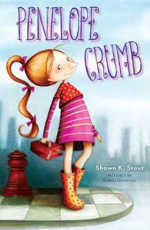 Fourth grader Penelope Crumb thinks more about death than most youngsters her age since her own father died many years ago. She carries around his old toolbox and records evidence that her brother is an alien. Despite her preoccupation with death, Penelope is remarkably well adjusted, and instead of becoming upset when her best friend portrays her with a large nose, which causes quite a bit of teasing from her classmates, she looks in the mirror and decides to embrace her noticeable nose which is larger than she had thought. Eventually, she learns that her estranged paternal grandfather has the very same nose. With help from a friend, Penelope locates her grandfather, and starts the process of healing between him and her mother who have not been in contact since her father’s death. Readers will enjoy meeting the self-assured Penelope as she draws inspiration from Leonardo da Vinci for her artwork and for her approach to life throughout the book. It's refreshing to find a protagonist who doesn't define herself through the remarks of her classmates and is able to see past the defenses others put around themselves in order to avoid pain. Filled with heart-felt sentiments about family dynamics, the book also contains snippets of humor through the descriptions of the behavior of Penelope’s teacher and her mother.
- Barbara A. Ward, Washington State University, Pullman
Woodson, Jacqueline. (2012). Each kindness. Illus. by E.B. Lewis. New York: Penguin/Nancy Paulsen Books.
 Chloe and her friends aren't interested in playing with the new girl, Maya. After all, Maya wears worn and old hand-me-down clothes and brings old toys to school. When Maya asks the girls to play with her on the playground, they turn their backs on her and continue to ignore her. As the school days go by and Chloe and her friends refuse to include Maya, she continues to play by herself. But one day, Maya’s seat in the classroom is empty, prompting Chloe to wonder where Maya might be. Eventually the teacher announces that Maya and her family have moved away. The teacher goes on to share a lesson about the ripple effect of your actions. Chloe feels guilty for the way she treated Maya and realizes that there is no way to take back her cruel actions now that Maya has gone. The author-illustrator team that created The Other Side (Putnam, 2001) has created another emotionally compelling and beautifully written and illustrated book sure to prompt classroom discussions about bullying and activities comparing the two books. The cover of the book is especially discussion-worthy. Teachers may be interested in reading an interview with the author on The Brown Bookshelf blog.
- Karen Hildebrand, Ohio Library and Reading Consultant
GRADES 4-5
Castle, M.E. (2012). Popular Clone: The Clone Chronicles #1. New York: Egmont.
 Fisher Bas is a sixth grade science and math wiz, but a social klutz in terms of his self-esteem. The Vikings, a group of bullies in his middle school, love to torment him, forcing Fisher to spend way too much time with his head in the toilet of the school restroom. Finally, fed up with dealing with the torment every day at school, Fisher makes use of his Nobel Prize-winning-scientist parents’ resources. Fisher steals the experimental growth hormone his mother is developing and creates a clone that he names Fisher Two, or just Two for short. When Two goes to school the next day, things don’t go as Fisher planned. Unexpectedly, Two seems to be immediately popular and even a bit of a troublemaker. He makes friends and exudes a confidence that Fisher hardly recognizes. However, evil scientist Dr. X has been eavesdropping on the hormone project and kidnaps Two, not realizing he is a clone. Fisher must save Two and keep both his clone project and his mother’s experiment from being exposed. As Fisher develops a plan to rescue Two, which includes blowing up a lab, the fun begins, marking the debut of an engaging series planned around Fisher and Two. A teacher’s guide and many more resources can be found at the book’s website and ReadWriteThink has a bully lesson entitled “A Bad Case of Bullying: Using Literature Response Groups."
- Karen Hildebrand, Ohio Library and Reading Consultant
Cheng, Andrea. (2012). The year of the book. Illus. by Abigail Halpin. Boston: Houghton Mifflin Books for Children.
 Fourth grader Anna Wang feels friendless after her friend Laura spends more time with other friends, especially the bossy Allison. Not only does she have to be in charge, but she enjoys belittling Anna. She makes fun of Anna's homemade lunch sack and other aspects of her personality and identity. When Laura makes efforts to rekindle their friendship, Anna isn't sure whether to trust Laura. Instead, she finds solace, insight into human nature and friendship in the classic children’s books she is reading. When turmoil in Laura's home life leaves her vulnerable, Anna once again offers friendship to Laura just when she needs it most. I love how painstakingly the author portrays Anna as she draws sustenance from her own family and literature. Her kindness is evident in the way she greets the school crossing guard, Ray, even visiting him when he has an accident. Anna's initial reluctance to learn how to speak and write Chinese plus her refusal to believe that Laura might actually be interested in her culture provide places to initiate classroom conversations about trust and acceptance. The author skillfully covers many important themes subtly while portraying sometimes shifting family dynamics accurately. If this is a year of reading for Anna, it is also a year filled with self-discovery. Adding to the pleasure of meeting Anna and watching her deal with the bullies who have shut her out, the pen-and-ink illustrations that have been colored digitally enable readers to see Anna and her world. The book even contains the directions and visuals for several of the projects Anna undertakes. For more information about the author, read the Reading Today Online interview with Andrea Cheng. Also see her "Readingwalking" post on the Engage Teacher to Teacher blog.
- Barbara A. Ward, Washington State University Pullman
Cotler, Stephen L. (2012). Cheesie Mack is cool in a duel. Illus. by Adam McCauley. New York: Random House.
 Cheesie Mack and his best friend Georgie from Cheesie Mack Is Not a Genius or Anything (Random House, 2011) are back with another adventure, this time taking them to Camp Windward on Bufflehead Lake in Maine. The boys worked hard to pay for camp where they would now be the oldest of the Little Guys and have some special privileges. Because their registration was a little late, they end up housed in the cabin with the Big Guys, putting them on the low end of the totem pole again, the smallest and youngest ones in the cabin. Unfortunately, this also meant they would share a cabin with Kevin Welch, not only a big bully but also the boyfriend of Cheesie’s older sister June, known as Goon to Cheesie. As Kevin begins his usual bullying treatment, Cheesie challenges Kevin to a Cool Duel. Each day the campers have to vote who did the coolest thing that day and at the end of the week the loser has to bow down to the winner. Readers are asked to become involved in some of the antics by going to Cheesie’s website for answers and help in these daily situations. Although the website offers additional fun, it is not necessary for readers to have access to the Internet to enjoy the story of Cheesie and George at Camp Windward. Visit Cheesie’s website and the author site.
- Karen Hildebrand, Ohio Library and Reading Consultant
Dallas, Sandra. (2012). The quilt walk. Ann Arbor, MI: Sleeping Bear Press.
 Conflicted about her father’s decision to leave the safety of their farm in Quincy, Illinois, for Golden, Colorado, where he plans to sell supplies to the gold miners, ten-year-old Emmy Blue Hatchett is also excited about the adventure. From the beginning, the journey is not easy as Emmy's mother and aunt must leave behind objects they cherish. As they head westward, Emmy is struck by how quickly luck can turn from good to bad. Although most of the travelers in the wagon train help each other out, there is one exception. Newlywed Mr. Bonner fails to pull his own weight, is arrogant and ill-tempered, and bullies everyone around him, particularly his bride, who constantly sports another bruise or sprain. The females in the party watch as his bullying escalates and look for avenues for her to escape. Although Emmy’s mother dutifully follows her husband's wishes to head west, she puts her foot down at various points and asserts her wishes. Throughout the story, Emmy pieces together the parts of a small quilt her grandmother gave her when she left Illinois, a task she hates at first, but comes to enjoy in some ways, while many of the other women work on their own quilts along the way. The idea of making something beautiful and useful from fabric scraps is a powerful theme that is threaded throughout the storyline. This chapter book with a feminist slant provides insight into the roles women played as their men headed toward a different kind of life.
- Barbara A. Ward, Washington State University Pullman
Gervay, Jack. (2012). I am Jack. Illus. by Cathy Wilcox. Berkeley: HarperCollins/ Kane Miller Books.
 Until now, life has gone pretty smoothly for 11-year old Jack who enjoys soccer and photography. However, his mother seems too busy and too involved with her new boyfriend to have time to talk and spend time with Jack right now. Jack’s life starts to change at school too when George Hamel, the school bully, selects Jack as his next victim and begins calling him names. Other kids pick up on the “butt head” moniker, and before Jack knows it, it seems as though the whole school has turned against him and is calling him by the name George has chosen for him. Finally, his best friend Anna tells her parents how Jack is being treated and that he now has severe headaches due to the stress. When Jack’s mother learns what is happening to Jack she marches into school to talk with the teacher and the principal. Teachers and parents will find it particularly interesting to read about the school administration’s response to the bullying and the program they put in place to stop it. This realistic story of how bullying can accelerate, escalating far past what a young child can endure or have the ability to combat it, provides several ways that schools, family and friends can intervene to put an end to the bullying. The author has a book trailer, bullying information and resources at her website. Teachers can find a lesson plan guide at the publisher’s website. For teachers who enjoy reader’s theater, a script with performance ideas can be found at the Arts Center of Melbourne website.
- Karen Hildebrand, Ohio Library and Reading Consultant
Martin, Ann M. (2011). Ten rules for living with my sister. New York: Feiwel and Friends.
 Siblings often have to negotiate with each other in order to insure harmony at home, and they sometimes compare themselves to one another. For nine-year-old Pearl Littlefield, any comparison with her popular older sister Lexie leaves her coming up short. Lexie has many interests and many friends, and values her privacy. Pearl, however, has little sense of personal space and only one friend, a much younger neighbor, with whom she spends her free time. She also hangs out with her cat, appropriately named Bitey. Additionally, Pearl feels uncomfortable at school because her classmates still remember three embarrassing incidents that occurred when she was younger, and frequently remind her of them. When the sisters' grandfather comes to stay while waiting for a placement in an assisted living facility, they are forced to share a room. This necessitates some compromises from both girls since their personalities and living styles are so different. Over the course of the book, though, they come to a mutual understanding and appreciate each other’s differences with Lexie even providing guidance for Pearl as she navigates the tricky school social world. By the time Pearl plans her own birthday party, she is confident enough to take risks, an ending that indicates her healthy self-concept. Remaining true to herself while also considering the wishes of others, Pearl is unlikely to become one of the school mean girls. The book is uplifting while exploring the development of imperfect but likable characters facing real-life challenges. Sometimes ignoring bullies simply doesn't work.
- Barbara A. Ward, Washington State University Pullman
Palacio, R.J. (2012). Wonder. New York: Random House.
 Ten-year-old August Pullman regards himself as rather ordinary, yet others see him as anything but normal due to his extreme facial abnormalities. Auggie explains the dissonance between how he sees himself and how others regard him: “But I know ordinary kids don’t make other ordinary kids run screaming in playgrounds. I know ordinary kids don’t get stared at wherever they go” (p. 3). His life is about to change once his parents enroll him as a new fifth grader at Beecher Prep School. This will be Auggie’s first experience in school since he has been homeschooled during the previous years due to his numerous surgeries. Not only must he deal with the looks and whispers of his new classmates but also a cruel game in which students that touch him and fail to wash within 30 seconds of contact will have “The Plague.” In addition to learning about the traditional subjects of language arts, social studies, science, and math, Auggie also learns powerful lessons about friendship, courage, loyalty, and betrayal. His school days teach him about overcoming unexpected challenges as well as introducing him to bullies and their abilities to coerce others into joining their cruel behavior toward someone such as Auggie who is considered different from the norm. Palacio skillfully narrates the story from alternating points of view, offering insights from Auggie and some of his classmates as well as his teenage sister and her friends. This is a WONDER-ful book, brimming with hope and possibilities balanced against thoughtless acts of unkindness based on ignorance.
- Terrell A. Young, Brigham Young University Provo
Spinelli, Jerry. (2012). Jake and Lily. New York: HarperCollins/Balzer + Bray.
 Almost 11, twins Jake and Lily Wambold have always been very close and share a special sense they call “goombla.” However, as time for middle school approaches, their parents think that it is time they each had their own bedroom. Jake is okay with this new arrangement, but Lily is not ready to give up the closeness they have always shared. Jake is starting to drift away as he finds a new set of friends that include Bump Stubbins and the Death Rays gang. Lily cannot stand Bump, the neighborhood bully, or the victims he singles out for harassment. Without Jake’s companionship, Lily is lonely and seeks out her grandfather Poppy for comfort. Poppy, a hippie in former days, provides the perfect solace for Lily since he, too, misses someone--his deceased wife, Lily’s grandmother, who was his life partner and other half as Jake has always been for Lily. When Jake’s new friends pick on Ernie, tagged a “goober” by Bump and his gang, Jake has to decide how much of their bullying behavior is acceptable and where to draw the line for his newly-found so-called “friends.” ReadWriteThink provides the lesson plan “Moving Toward Acceptance through Picture Books and Two-Voice Texts” about bullies. Teachers may want to visit this award-winning author’s website.
- Karen Hildebrand, Ohio Library and Reading Consultant
Starkey, Scott. (2012). How to beat the bully without really trying. New York: Simon & Schuster Books for Young Readers.
 Slightly reminiscent of Jeff Kinney’s Diary of a Wimpy Kid series, this debut from a middle school teacher author features a funny tale about Rodney Rathbone and his transformation from wimp to tough guy. Rodney Rathbone has recently moved from New York City to small-town Ohio and hopes that he has left his picked-on persona behind him. Rodney has always been terrified of everything. On his first day of school in his new middle school, he steps into a confrontation with Josh, the school bully, when a stray baseball hits Josh and breaks his nose. Word soon gets around that Rodney has clobbered Josh, and Rodney immediately inherits an entirely new reputation that turns him into the new tough guy around school. With new-found confidence and maybe a bit of attitude, Rodney starts to live up to this new persona. Many of the ensuing situations are a bit farcical, but they will amuse readers. A sequel might be on the horizon. The author discusses how he came to write the book in a video at Daily Motion.
- Karen Hildebrand, Ohio Library and Reading Consultant
GRADES 6-8
Barnhill, Kelly. (2012). The mostly true story of Jack. New York: Little, Brown Books for Youth.
 Moving from San Francisco to Iowa is a real jolt for Jack whose parents have recently divorced and taken him to live with his quirky aunt and uncle Mabel and Clive Fitzpatrick in Hazelwood, Iowa. Although Jack has spent his life thus far trying to stay under the radar of the local bullies in San Francisco, from the minute he sets foot onto Hazelwood soil, he seems to be the new target in town. Jack is able to make friends with Wendy and Frankie, 14-year-old twins, who help him better understand some of the strange disappearances of people and buildings in this eerie town. Mystery and magic come into play as Jack learns more about the powers of evil that are loose in Hazelwood. This debut fiction author employs the power of friendship to combat good and evil in this suspenseful tale. Teachers can find a downloadable educator’s guide at the publisher’s website. Lesson ideas for incorporating anti-bullying concepts can be found at Teacher’s Domain.
- Karen Hildebrand, Ohio Library and Reading Consultant
Barwin, Steven. (2010). Fadeaway. Toronto: James Lorimer & Company Ltd.
 An excellent basketball player, seventh grader Renna Rashad of Richmond Hill loves the sport and is even captain of the school team, the Hornets. When her good friend and teammate Caitlyn moves from Toronto to Vancouver, Kate joins the basketball team, which is disconcerting for Renna since she used to play for the Hornets’ rival team, the Warriors. Kate is uninterested in Renna’s advice about the team, and behaves rudely toward her. She mounts a campaign to make Renna’s life miserable by excluding her in every social interaction, making costly mistakes during games, physically hurting her, and finally leaving nasty messages on the team’s page. She even resorts to name calling, saying that Renna is a Resol or Loser spelled backwards. Renna becomes snappish with any teammates who are friendly with Kate. Finally, she breaks down and confesses the situation to her friends who then try to trap Kate into bullying Renna in front of a teacher. The strategy backfires when Kate accuses Renna of bullying. Left with no other option, Renna confronts the bully in her life. In the end, Renna and Kate make peace and confront the bully who tormented Kate at the first place. This is a slim, action-filled volume showing exactly how subtly bullying can be perpetuated. Everyone involved in team sports should read this book.
- Rani Iyer, Washington State University Pullman
Yee, Lisa. (2011). Warp speed. New York: Scholastic/Arthur A. Levine Books.
 Seventh grader Marley Sandelski feels invisible in Rancho Rosetta Middle School. He is not like his former friend, the good-looking, athletic Stanford Wong, who Marley thinks comes from planet Mercury. Nor is he from planet Venus, inhabited by the teachers’ favorite students and those who are active in student organizations. Like the rest of the regular kids, who are neither popular nor unpopular, Marley is simply from planet Earth. Marley lives with his parents in the Rialto, a historic movie theatre in their town. His mother is a piano teacher, and although blind, she leads an active life, fending away pity that is often directed at her. Despite his invisibility to most of his classmates, Marley is all-too visible to Digger, the son of an affluent man. While Digger bullies and blackmails Marley for his history homework, three other boys known as the Gorn indulge in punching him. Marley finds himself unexpectedly attracted to Emily and begins to care for his dress and appearance. This alienates him from his usual group of friends from the AV club—Max and Ramen. When he must run to escape from the Gorn, Marley discovers hidden talents--he can run super-fast--and catches the eye of the track coach who wants him to sign up for the team. But, despite winning the coveted Tiggy Tiger Turkey cup in a record time, Marley’s heart is not in sports. Somehow, though, he inspires his classmates to rise up collectively against the Gorn. In this title, the author describes the life of a die-hard Star Trek fan while portraying the life of middle school students perfectly. Although humorous moments are sprinkled throughout the book, sensitive readers may wince at the graphic bullying scenes that continue until almost the last page. The book is excellent for group reading and discussions. Also see a video interview of Lisa Yee on the Engage Teacher to Teacher blog.
- Rani Iyer, Washington State University Pullman
GRADES 9-12
Altebrando, Tara. (2012). The best night of your (pathetic) life. New York: Dutton Juvenile.
 Mary Gilhooley is relieved that high school has come to an end. Although she didn’t win the scholarship to Georgetown that she expected, still, she’s on her way out of town and on to college. Because she and her friends didn't leave much of a mark on their school, she figures they have one night left to salvage the year and insure that they’ll be remembered. The seniors of Oyster Point dedicate one night at the end of the year to a scavenger hunt for various items, some fairly easy to locate and others described somewhat vaguely. As the friends try to figure out clues and track down items on the list to rack up points, the night turns out to be eventful in unexpected ways. Friends are betrayed, crushes are revealed, and Mary herself realizes that despite her hatred of a boy who has dogged her throughout high school, she hasn't always treated him kindly. She has an epiphany while pondering her own need to be in charge and the way she verbally shot him down years ago. Although the characters are not particularly complex, readers will root for Mary and her also-ran friends to win, notching a victory for the underdogs, or if not that, realizing that there is more to life than high school. The book’s pleasant surprises and musical references are sure to send readers scurrying off to search for music by some long-forgotten bands and to plan their own senior class scavenger hunt.
- Barbara A. Ward, Washington State University Pullman
Colasanti, Suzanne. (2012). Keep holding on. New York: Viking Juvenile.
 Life couldn’t be tougher for junior Noelle Wexler. Her mother, embittered by the disappointments in her own life, barely talks to her daughter except to blame her for her life and to complain about her job. Since there is often very little to eat, Noelle is forced to put together sandwiches made from mustard, mayonnaise, and lettuce for her school lunch. Her more affluent classmates either pity or belittle her for being poor while the teachers stand by and do nothing. Even Noelle’s ill-fated romance with Matt is hidden from everyone since he doesn’t want his peers to know how he feels about her. By the time Noelle is attracted to Julian Porter, she doubts that she is good enough for him. But Julian and a handful of her classmates aren’t overly concerned with their classmates’ opinions. When one of Noelle's classmates commits suicide after being teased repeatedly, her death compels Noelle to confront all the bullies in her life. The book is a good reminder that there is more to life after high school if you can just keep holding on until graduation.
- Barbara A. Ward, Washington State University Pullman
Hall, Megan Kelley, & Jones, Carrie (Eds.). (2011). Dear Bully: 70 authors tell their stories. New York: Harper Teen.
 Sometimes seeing ourselves in stories leads to change. This wonderful themed collection about bullies is for anyone who has bullied others, been bullied by others or even stood by helplessly while someone else was being bullied. It should be mandatory reading for students and teachers since it covers the territory of bullying so thoroughly. It is likely that each reader will find his/her own experiences mirrored in at least one of the stories written by the 70 authors, many of whom will be familiar to young readers. Some of the stories are long, and some are short, and the authors employ varied writing styles to tell their stories. Another bonus was having the authors' websites included in their bios in the back. Readers might want to savor this one in sips rather than reading the whole book in one session since the subject matter is often so painful. It's clear that bullying remains a problem in our world, especially in our schools, and some readers may find coping mechanisms such as humor and confrontation as the result of what some of the authors share about their own experiences. Others look back at bullying from the distance of a decade or two and are surprised to find that it still hurts to have been singled out or ostracized or even replaced by friends for various reasons. Still others are surprised to realize that the bullies of their childhood don’t even remember events that were so life-changing for them. In her provocative “Who Gives the Popular People Power? Who??" author Megan McCafferty ponders the essence and power of popularity. Not surprisingly, some of the authors describe the grudges they still hold toward the bullies from their growing up years and how they, too, sometimes became bullies after having been teased repeatedly. Readers can find even more stories, videos, and suggestions about how to get help at the authors’ website. Also see "5 Questions With...Megan Kelley Hall and Carrie Jones" on the Engage Teacher to Teacher blog.
- Barbara A. Ward, Washington State University Pullman
Knowles, Johanna. (2012). See you at Harry’s. Somerville, MA: Candlewick Press.
 Fern is the twelve-year old member of a family bustling with activity. Her father is totally absorbed in the family’s restaurant called Harry’s; her mother is often off meditating; her older sister is taking a gap year after high school before setting off to college; her older brother Holden is starting his freshman year in high school and dealing with coming out as gay; and her adorable 3-year-old brother, Charlie, although always messy, is the family’s shining star and the recipient of much love and attention. Fern’s best friend Ran takes life in stride while assuring Fern that everything will be fine as life progresses. A terrible accident changes all these dynamics. While in Fern’s care, Charlie is hit by a car, and the aftermath brings the harried family together in ways they never imagined. Teachers may be interested in additional literature bullying resources available at ReadWriteThink’s “Books about Bullying” or they may want to check out Teens Against Bullying. The author’s website offers tips for writing and more.
- Karen Hildebrand, Ohio Library and Reading Consultant
Rosenfeld, Kat. (2012). Amelia Anne is dead and gone. New York: Penguin/Dutton Juvenile.
 Two completely different lives and stories intersect in an unexpected way in this satisfying thriller. Although they live in different worlds, Becca and Amelia Anne have quite a lot in common. Amelia Anne plans to pursue an acting career after receiving encouragement from an instructor. Small-town girl Becca can’t wait to leave her town and her lackluster past for college. But her feelings for James and confusion over his decision to break up and then get back together right after her high school graduation make leaving harder than she expected. While she procrastinates about packing and preparing to go, James seems to be behaving rather oddly. Where is he going when he tells others that he’s spending time with her? The book opens with Amelia Anne already dead, leaving readers to decide who is responsible for her death on the side of the dirt road near Becca's town. How could a woman on her way to a beach vacation with her boyfriend die so violently? Masterfully hinting at each character's motivation, and omitting details so readers must read between the lines to form their own conclusion, the author tosses in a few red herrings to add to this suspense thriller's delight. Through her own short-sightedness and paranoia, Becca betrays herself and someone else, leading to tragedy. Readers will surely ponder the winding roads and detours that lead us to or from our destinations as well as what exactly constitutes bullying.
- Barbara A. Ward, Washington State University Pullman
Spottswood, Jessica. (2012). Born wicked. New York: Putnam Juvenile.
 In an alternative version of 1900 New England sixteen-year-old Cate Cahill and her two younger sisters, Tess and Maura, must keep secret the fact that they are witches with various powers that have yet to be harnessed. Their father has left them in the care of a woman from a group known as the Sisterhood. While Cate desperately tries to find clues as to what her deceased mother would want her to do, she must hide her abilities from the Brotherhood, a vigilante group of witch-hating men who determine marital partners. Girls and women who misbehave or behave inappropriately are sent to Harwood, which sounds downright Draconian. Options for women are limited at best, and Cate fears being paired with someone she doesn't love. Meanwhile, Cate is assailed by thoughts of romance and desire for someone considered unsuitable for her. When she makes a difficult choice in order to save her sisters, she also breaks her own heart. Of particular note is the way in which the town's witches--and there are more of them than just the three Cahill sisters--exist right under the noses of the Brotherhood. Readers will certainly be reminded of our own nation’s past, present, and future when reading about this imaginary society’s missteps as one powerful group oppresses another. It’s hard to say which is more frightening, the individual teasing directed at those such as Cate who are different from the others in the town or the bullying of the Brotherhood toward all women.
- Barbara A. Ward, Washington State University Pullman